The Official Cannabis Independent strain guides
The Official Cannabis collection · sheet 57No 57 · Cheetah PissUniverse

The Cheetah Piss universe

The Navigator

If Cheetah Piss is your strain, this is your sign: the Navigator. The last stage before sundown, the long grass gone gold, and you out of the passenger seat with the roadbook open and a pencil ready, three turns ahead of the truck.

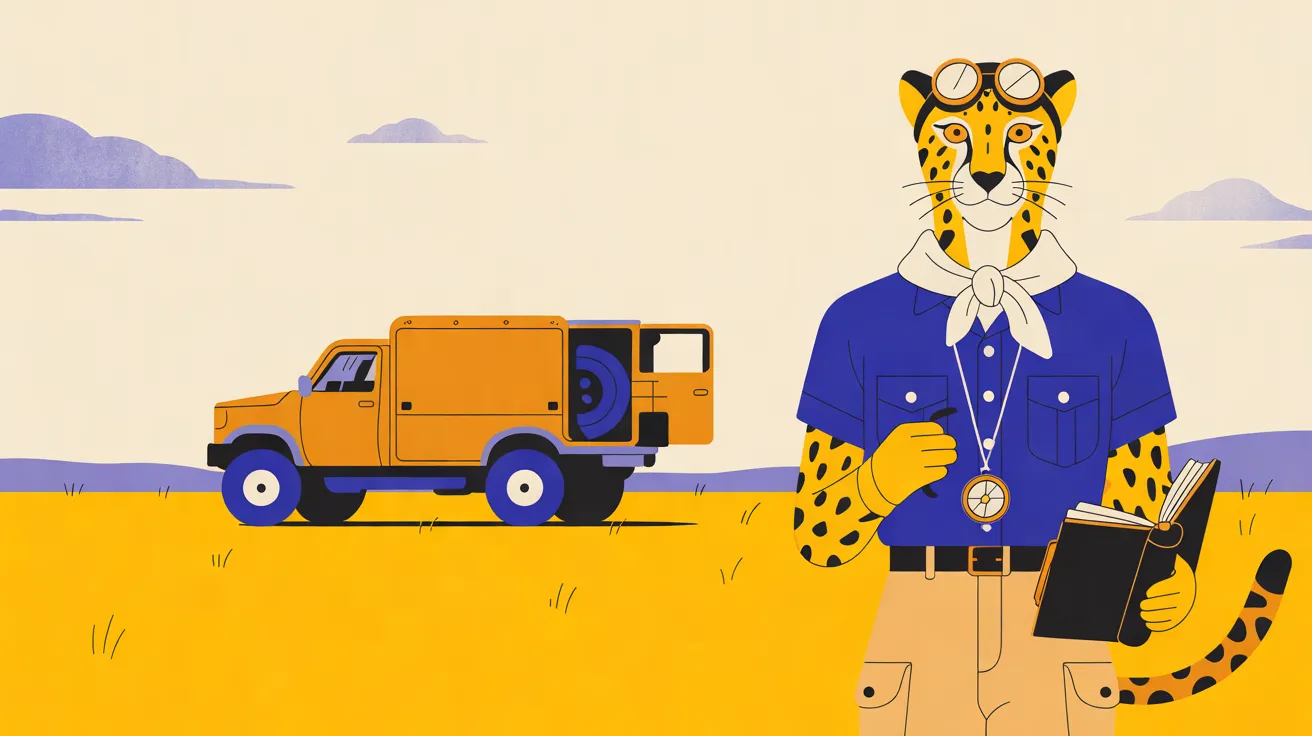
The Navigator, an upright adult cheetah with dark tear lines, stands at the right facing the viewer, shown from the thighs up in a deep-blue short-sleeved shirt, a cream neckerchief and sand-colored cargo trousers, with round goggles pushed up on her forehead and a brass compass on a cord around her neck; she holds a pencil in one hand and an open black roadbook in the other. Behind her a boxy amber off-road truck with blue wheels and an open rear door stands on golden grassland under a cream sky, with low lavender hills and clouds on the horizon.
Clouds drifting over the long gold grass while the compass settles on the last bearing.

If Cheetah Piss is your strain

You are the one in the passenger seat, and you would not trade it for the wheel. Somebody else can steer. You have the next three turns, and you had them before anyone asked. People hand you the map without thinking about it, and then they stop worrying about where they are going, which is the whole point of you.

You move fast without hurrying. You read ahead, you count, you call the turn half a second before it arrives, and you say it once, clearly, in a voice that does not go up when the ground gets rough. That calm is the thing people remember about you. They think it is nerve. It is mostly preparation: you were awake before the others, going over tomorrow’s boxes with a pencil.

At your best, the map is wrong. Everybody else goes quiet when the landmark is missing and the trail runs out into grass; you close the book, hold the compass level, and find the line anyway. You are not showing off when you do it; you would honestly rather the map had been right. Then you fix it, neatly, so the next person never knows there was a problem.

Your flaw is that you read so far ahead you miss what is in front of you: the sunset you have been driving into all afternoon, the zebra that looked up as you passed. You also cannot leave a mistake in someone else’s map alone. You have corrected strangers’ directions. You have corrected signposts.

What you need is a sharp pencil, a compass that settles, a driver who keeps left when you say left, and, once a day, someone beside you who says “look up”. You always do. You are always glad. Give you that, and nobody in your truck will ever have to ask where they are.

Your sign at a glance

Your hour
The last stage before sundown
Your place
The passenger seat of an amber truck
Your object
A brass compass and a roadbook
Your tempo
Three turns ahead
Your weather
Gold dust on a dry wind
Your flaw
You correct other people’s maps

Your people

  • The Mountain Elder (Hindu Kush)The Mountain Elder is the family’s other big cat, up where the passes are. He sends you weather; you send him bearings. Neither of you has ever been lost, and neither of you would mention it.
  • The Night Courier (Sour Diesel)The Night Courier knows every shortcut in his city and refuses to write a single one down. You have offered him a roadbook. He has offered you a bicycle.
  • Cindy at Midnight (Cinderella 99)Cindy watches the clock; you watch the sun. You both know exactly how much is left, and you both get there anyway.

Things you say

  • Two hundred, keep left at the lone tree. There is always a lone tree.
  • I don’t need to see it. I need to know where it is.
  • When the book is wrong, the compass isn’t.
  • Ribbed sand holds. Smooth sand lies.
  • Slow is a direction too.

A scene from your world

Box ninety-seven

The amber truck runs north through the long grass on the last stage of the day, and the dust it raises hangs behind it like a second, slower truck. In the passenger seat the Navigator has the roadbook open on her knee and the brass compass on its cord, swinging a little with every rut. “Two hundred,” she says. “Keep left at the lone acacia.” The driver keeps left. There is always a lone acacia.

She reads three boxes ahead of the wheels, because that is where the trouble is, her tail curled around the seat post and her ears turning at every change in the engine. Box forty-two, the fork at the termite towers: three red mounds taller than a person, exactly where the book says, and she ticks them off with the pencil from the spine before the truck reaches them. A line of zebras lifts its heads, decides the truck is not interesting, and goes back to the grass. The light is turning the color of the truck.

Box ninety-six says: cross the dry river at the white stone. The river is not there. The rains have moved it. Where the book has grass there is a new channel of pale sand, and where the book has a white stone there is nothing at all. The driver lifts off the throttle and looks at her, the way drivers do when the book has been right all day.

The Navigator closes the roadbook. She holds the compass level on her palm and waits for the needle to stop arguing. Due north, the flat-topped hill where the last flag should be. To the left, the sun, low over the grass. She looks at the sand, at the places where it lies ribbed like a washboard and the places where it lies smooth. “Straight on,” she says. “Slow. Stay on the ribs. Keep the sun on your left cheek.”

The truck goes down into the channel and the wheels find the ribbed sand and hold. It climbs out the far side in a long gold breath of dust. Ahead, on the little rocky hill, a blue pennant snaps in the wind, catching the last of the sun before anything else does: box ninety-seven, the end of the stage, exactly where her pencil said.

While the driver shuts off the engine, she opens the book to box ninety-six, crosses out the white stone, and draws the new route in the margin: the channel, the ribs, an arrow, the sun on the left. Small and neat, for whoever comes this way tomorrow. Then, because the driver has not said anything and is looking past her, she looks up. The whole sky has gone the color of the truck.
The route

The long grass
Pale gold and taller than the wheels, it runs to every horizon. The trail through it is two thin lines that only the roadbook can see.
The roadbook
Spiral-bound, one box per turn: a distance, an arrow, a landmark. It is right all day. When it is not, the pencil lives in the spine.
Box forty-two
The fork at the termite towers, three red mounds taller than a person. Keep left. Everybody keeps left.
The dry river
A road of pale sand that moves after every rain. Where the sand is ribbed it holds the wheels; where it is smooth it does not.
The lone acacia
Every roadbook on the route has one. There are, in fact, several.
The last flag
A small blue pennant on a rocky hill at box ninety-seven, the end of the stage. It catches the last of the sun before anything else does.

The Navigator, from every side

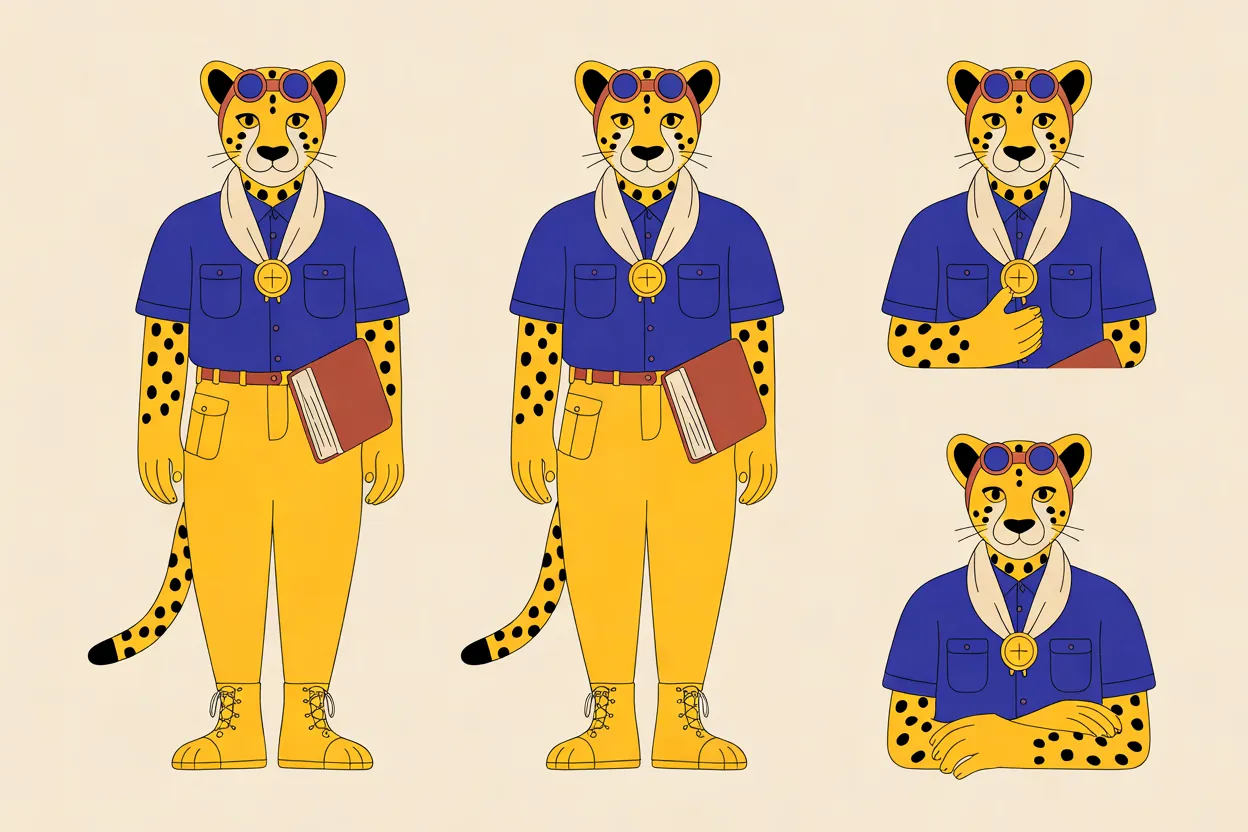
The Navigator character sheet on a warm cream background: two identical full-length front views of her standing with her arms at her sides and a red-brown book tucked against her hip, and two head-and-shoulders close-ups, one with a hand on the brass compass at her chest and one with her arms folded, all with the same calm, closed-mouth expression. In every view she wears round goggles with blue lenses pushed up on her forehead, a cream scarf, a deep-blue short-sleeved shirt and yellow cargo trousers with lace-up boots.
The Navigator standing and up close: goggles up, compass on its cord, roadbook shut under one arm, and the one calm face she keeps for a long stage, from calling the first turn to the moment the last flag comes into view.

An original character, created for Cheetah Piss by Official Cannabis. Art direction by Official Cannabis.

Wear the next waypoint

Pieces from this world come on a tee, a hoodie, stickers, a mug and a print.